
Sealed bid auction software is a digital platform that handles all aspects of a sealed tender event, including buyer registration, winner selection, automated invoicing, and payment settlement. Every offer is submitted privately. Quintagroup has created customised sealed bid platforms for fish and seafood markets, B2B procurement groups, real estate operators, and government agencies. We handle workflows that standard tools cannot.
What Is a Sealed Bid Auction and How Does It Differ From a Public Auction?
Every participant in a sealed bid auction places a silent, independent bid within a predetermined window of time. No one is able to view the offers made by other bidders. The vendor opens all submissions at once after the deadline and selects the winner based on predetermined standards.
This privacy approach fundamentally changes the competitive dynamic. Buyers submit their genuine best offer from the start, as they cannot assess each other's pricing beforehand. The result is a win-win: a stronger, more honest pricing for the seller, and a process that is straightforward to document and audit. This combination sets the sealed bid format as the global standard for regulated sectors, B2B commodities transactions, and government procurement.
There are 2 types of this format:
First-price sealed bid
The highest bidder wins and pays their stated price. This is the most widely used format in commodity auctions, fish markets, real estate silent sales, and procurement tendering.
Second-price sealed bid
The highest bidder wins but pays the second-highest price submitted. Used in procurement and advertising scenarios where the goal is to encourage maximum-value, honest bids.
Sealed Bid vs English Auction: Which Format Fits Your Business?
Quintagroup builds platforms that support both primary auction formats within the same system, allowing businesses to choose the model that fits each transaction type.
English Auction (Ascending Bid) |
Sealed Bid Auction (First-Price) |
|
|
Core Logic |
Bids are placed openly in ascending rounds Each bid must beat the current high |
Each bidder submits one confidential bid, and no one sees competitors' offers |
|
Bid visibility |
All bids are visible in real time to all participants |
Bids are hidden until the auction closes and are disclosed together |
|
Winning rule |
The highest bid when the timer expires wins the lot |
The highest submitted bid wins at their offered price |
|
Main difference |
Price discovery is live, and the bidders react to each other's moves |
Price is hidden. The bidders must estimate the true value in a single decision |
|
Industries that Use |
Fish & seafood markets Agricultural spot sales Art & estate auctions Industrial surplus |
Government procurement Real estate silent bids B2B industrial tenders Commodity contract bids |
In short, the English auction works best when visible competition drives value (art, equipment resale, retail), while the sealed bid format is the choice when fairness, confidentiality, and a documented process matter more.
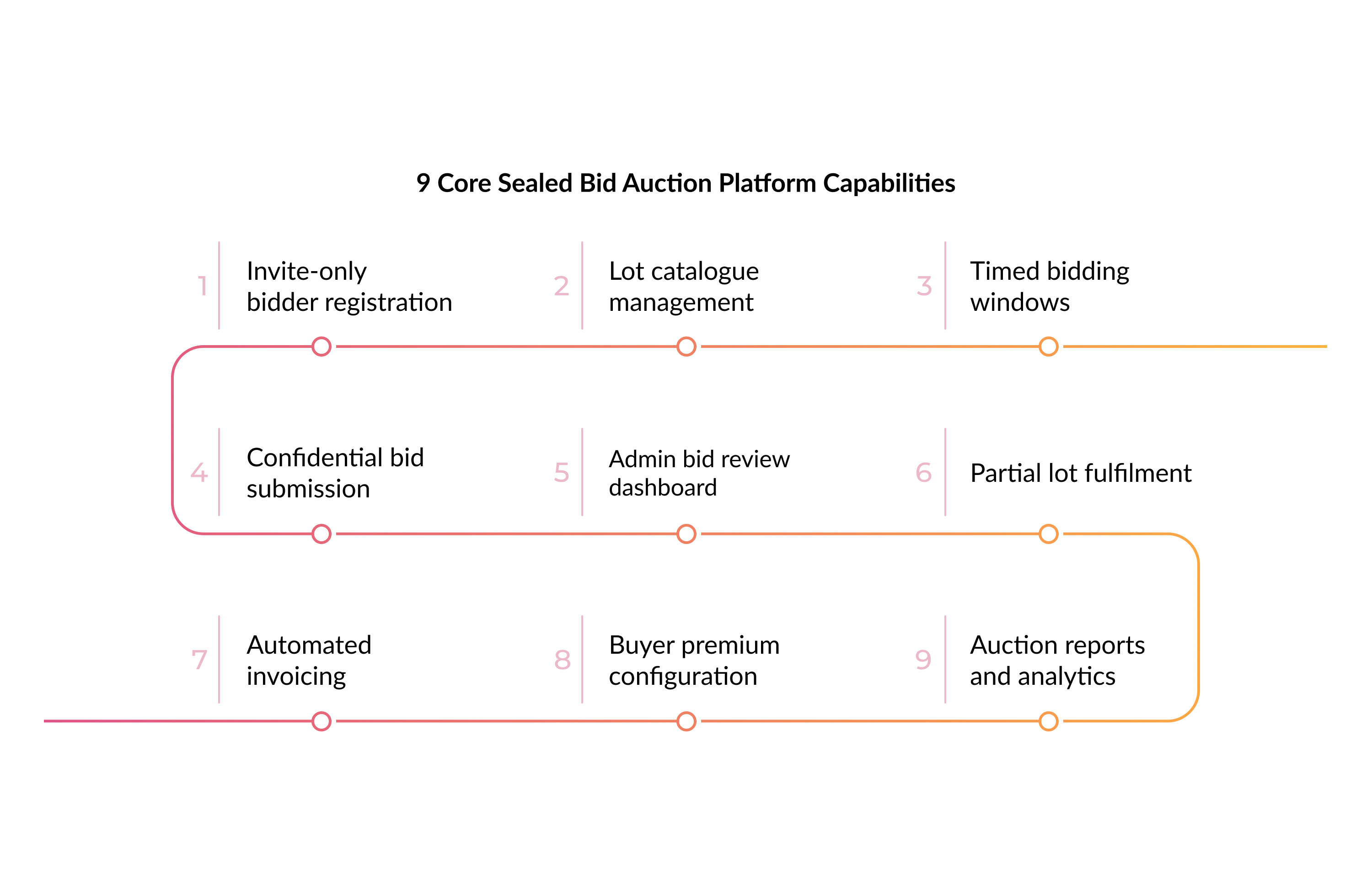
9 Core Sealed Bid Auction Platform Capabilities
Quintagroup's sealed bid auction platform covers every stage of the event lifecycle, from lot creation to invoice payment, with no need for extra tools or manual data entry at any time:
1. Invite-only bidder registration
This feature gives the seller the ability to control who participates. Buyers register through a secure portal and receive individual access credentials. Public open registration is available when the client requires it, but most B2B deployments run on invite-only access.
2. Lot catalogue management
Lots are created with titles, descriptions, images, starting price, reserve price, available quantity, and any custom fields needed. Bulk import from CSV or connected inventory systems is supported.
3. Timed bidding windows
Each auction runs between a fixed start and end time. Bidding closes automatically at the deadline, which eliminates the last-second sniping and ensures every participant has the same opportunity regardless of time zone.
4. Confidential bid submission
Each buyer submits their offer through their personal portal. No other participant can view submitted bids during the bidding window. The sealed record is maintained until the seller releases the results after close. This is the feature that makes the format suitable for regulated procurement: there is no mechanism by which one buyer's offer can influence another's before the deadline.
5. Admin bid review dashboard
After the auction ends, the seller can view all offers ranked by price. A complete timestamped audit log is generated automatically and can be exported.
6. Partial lot fulfilment
The seller can accept bids from multiple buyers against a single lot, allocating a portion of the available quantity to each winning bidder. Each buyer receives a separate invoice for their accepted quantity and price. This is the standard operational model for fish market auctions and bulk commodity salesю Quintagroup has built partial fulfilment logic for fish auction platforms processing hundreds of lot allocations per session.
7. Automated invoicing
Invoices are created immediately after the auction ends. Buyers can access and download invoices through the site or receive them via email automatically.
8. Buyer premium configuration
A percentage or fixed fee per auction is configured once and applied automatically to all invoices without manual calculation.
9. Auction reports and analytics
On-screen dashboards and downloadable PDF reports that include all the key metrics are available after every event. Historical data accumulates across events for trend analysis.
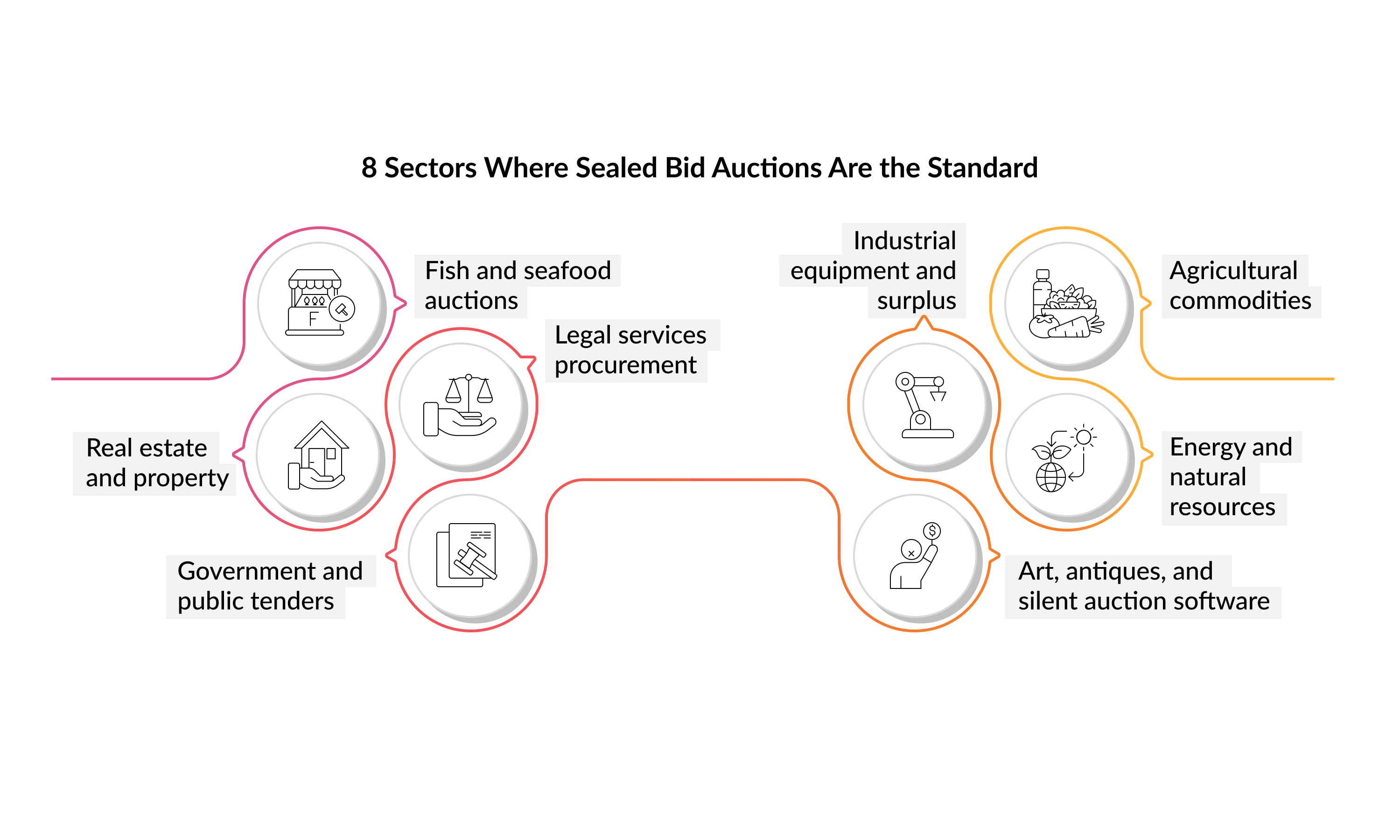
8 Sectors Where Sealed Bid Auctions Are the Standard
Sealed bid auctions are used wherever confidentiality, fairness, and documented price discovery are a must. The following eight sectors account for the majority of Quintagroup's sealed bid deployments:
1. Fish and seafood auctions
Daily catch auctions at ports where buyers submit sealed bids on boxes of fresh fish. The seller reviews all offers and allocates quantities to multiple buyers from a single landing using partial lot fulfilment. Quintagroup has delivered fish auction platforms for port operators processing hundreds of lots per morning session.
2. Legal services procurement
Organisations managing outside counsel selection and legal vendor tendering require confidential, conflict-checked bid processes with structured evaluation criteria.
Use case: CounselOps, a platform developed by Quintagroup, handles sealed pre-bids, automated conflict-of-interest checks, and structured scoring for legal procurement workflows.
3. Real estate and property
Silent bid sales where open competitive bidding is unfeasible or unwanted. Supports reserve prices, multi-property event management, and buyer due diligence document distribution before bidding opens.
4. Government and public tenders
Public sector procurement requires tamper-proof sealed submissions, full audit trails, and documentation that satisfies regulatory compliance requirements. The sealed bid format is the standard for public contract awards.
Use case: Quintagroup contributed to the development of ProZorro.Sale. It is Ukraine's national open procurement system, recognised internationally as a benchmark for transparent government tendering. Quintagroup built the electronic auction module that manages competitive bidding rounds, including the Insider Auction format in which one of three stages operates as a sealed bid round. Since launch, the platform has processed approximately 192,000 procedures, completed over 9,000 auctions, served 7,700 registered participants, and generated $393M in total revenue, with an average minimum price increase of 13.57% per auction. The platform operates across 60 connected e-procurement platforms.
5. Agricultural commodities
Bulk agricultural goods are sold through lot-based sealed auctions, which support complex grading attributes, quantity-based partial allocation, and integration with different management systems.
6. Industrial equipment and surplus
Machinery, fleet vehicles, and surplus inventory disposed of through timed sealed bid events with pre-qualified buyers. Some standard options include: condition grading, inspection documentation attachments, and reserve price protection.
7. Energy and natural resources
Structured sealed tender processes show up in high-value situations where confidentiality and legal-grade documentation are non-negotiable.
8. Art, antiques, and silent auction software
Discreet bidding environments for galleries, estate sales, and charity fundraisers. Invite-only participation, full lot image galleries, and mobile-friendly buyer portals with integrated payment systems allow winners to settle immediately after results are announced.
Invoicing and Payment Gateway Integration
Quintagroup designs each auction system with a complete post-auction workflow, ensuring that the transition from bid acceptance to collected payment is seamless and practically unnoticed, requiring no tool switching or manual data entry.
The moment a seller confirms winning bids, the system generates individual invoices with all the required information for each buyer. Buyers can access invoices through their portal and receive them by email.
Invoice-based settlement |
Integrated online payment |
|
The standard model for B2B contexts where buyers pay by bank transfer or agreed credit terms after the event. Covers: fish market auctions, commodity sales, and procurement. No online payment is required at the point of bidding. |
Available for platforms where immediate card or digital wallet payment is preferred. Integrates with: Stripe, PayPal, and Adyen. Multi-currency support is available for international auction platforms operating across multiple markets. |
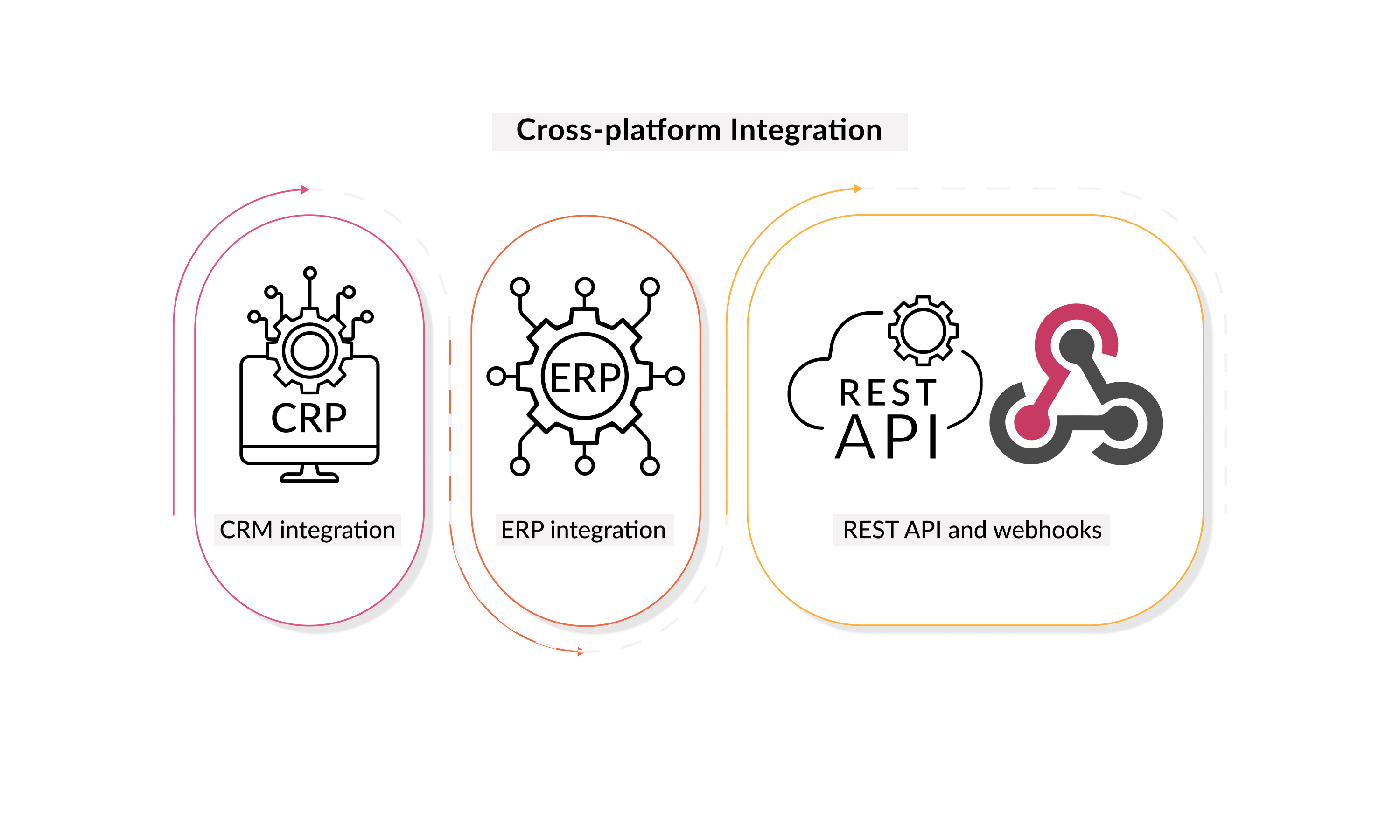
Cross-platform Integration: CRM, ERP, API
Auction platforms that operate in isolation create data silos and reconciliation work after every event. Quintagroup designs sealed bid platforms as connected components of the client's broader business infrastructure from the start.
Here’s what we use for the seamless incorporation:
CRM integration:
- Connects the auction platform to Salesforce, HubSpot, Pipedrive, or a custom CRM system.
- Every registered bidder, bid placed, and lot won is reflected in the buyer's contact record automatically.
- Sales teams gain a complete view of buyer activity.
ERP integration:
- Allows auction invoices, payment status, and inventory movements to flow directly into the ERP system on auction close.
- Eliminates manual re-entry of financial data, keeps stock records accurate in real time, and ensures auction revenue passes through the same accounting and reporting pipelines as the rest of the business.
- Quintagroup has delivered ERP-connected auction platforms integrating with Odoo and custom internal systems.
REST API and webhooks:
- All platforms are delivered with a clean REST API to support integration with logistics systems, port management software, warehouse management systems, or any proprietary platform the client operates.
- Webhook support enables real-time event-driven updates to downstream systems on auction open, close, bid submission, and invoice generation.
Quintagroup Auction Delivery Framework
Quintagroup approaches every auction platform as a custom infrastructure project, not a software configuration task. The process begins with a structured discovery session (3 to 5 working days) during which the team maps the client's event workflow, buyer relationships, lot structure, and integration requirements. Then, the Auction Delivery Framework (ADF) approach is used. It is a five-phase methodology covering process discovery, module evaluation, custom development, integration and access setup, and production launch.
Development runs in two-week cycles with working software reviewed at each stage. Deployments typically reach production in 8 to 14 weeks, depending on integration complexity. Quintagroup has delivered all three:
- A fish auction platform connecting to port management software and splitting the daily catch across multiple buyers.
- A government tender system requiring role-separated access controls and formal audit exports.
- A real estate silent auction with document distribution and Stripe payment at close.
Recent engagements include the ProZorro electronic auction module, which is the competitive bidding component of Ukraine's national public procurement system.
Get a Scoped Estimate for Your Sealed Bid Platform
Tell Quintagroup about your process. We want to know everything: industry, event frequency, buyer relationships, and integration requirements. The team will design a platform around your workflow and provide a delivery plan with a fixed timeline and cost estimate within 5 business days. Contact us today to get started.
Frequently Asked Questions
What is sealed bid auction software?
Sealed bid auction software is a digital platform that manages private, time-bound bidding on lots. It collects confidential offers from buyers, revealing all submissions simultaneously at the deadline, and automates winner selection, invoicing, and payment. It is used in fish and seafood markets, B2B procurement, real estate, government tendering, and agricultural commodity sales.
How does a sealed bid auction work in practice?
The seller creates lots in the system with descriptions, images, quantity, and a reserve price. Buyers log in to their individual portal and submit a private bid before the deadline. When the auction closes, the seller sees all bids ranked by price and confirms winners.
What is partial lot fulfilment, and which industries use it?
Partial lot fulfilment allows a seller to accept bids from multiple buyers against a single lot, allocating a share of the available quantity to each winner. Each buyer receives a separate invoice for their accepted quantity. It is the standard model for fish and seafood auctions, grain sales, and bulk commodity markets.
Does the platform integrate with ERP and CRM systems?
Yes. Quintagroup builds auction platforms with integration to Salesforce, Odoo, and custom platforms. ERP integration pushes invoices, payment status, and inventory movements into the accounting pipeline on auction close.
Which payment gateways are supported?
The platform supports invoice-based settlement and integrated online payment via Stripe, PayPal, and Adyen. Multi-currency support is available for international platforms. The payment model is configured per deployment, as most B2B clients use invoice settlement, while art, charity, and real estate platforms typically use integrated card payment at close.
Is this suitable for government procurement and public tenders?
Yes, and it is the legally required format in many jurisdictions. Quintagroup built the auction module for ProZorro.Sale, which has processed approximately 192,000 procedures and generated $393M in revenue since launch, with an average price uplift of 13.57% per auction. That is the operational scale and compliance standard Quintagroup has built to.
How long does it take to build a sealed bid auction platform?
A standard deployment typically takes 8 to 14 weeks from discovery to production. Timelines depend on integration complexity, the number of auction formats required, and third-party system connections. Quintagroup provides a scoped estimate after the initial discovery session.
How is Quintagroup's approach different from off-the-shelf auction software?
Quintagroup builds platforms from the ground up to fit each client's specific workflow. Off-the-shelf tools require the business to adapt to the software's constraints. Quintagroup's clients include port operators running daily fish auctions, procurement organisations managing government tenders at a national scale, legal services platforms with conflict-of-interest checks built into the bid process, and commodity exchanges with complex lot allocation rules that no packaged product supports.