
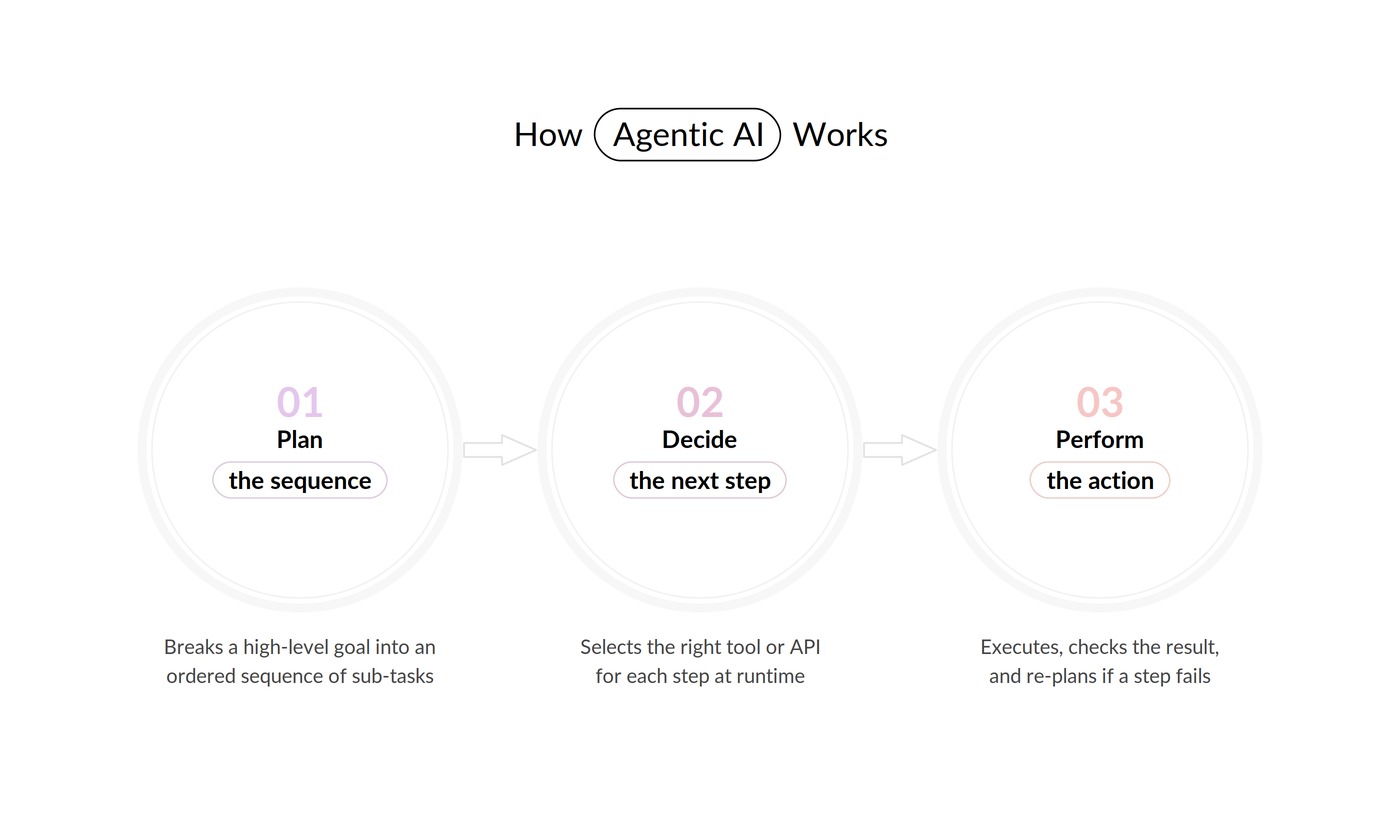
Agentic AI solutions are AI systems that plan, decide, and perform multi-step activities to achieve a goal with minimal human intervention. An agentic system divides a task into steps, contacts tools or APIs, checks its own results, and continues until the goal is accomplished. It holds a goal in memory and selects the right tool for each sub-task. Quintagroup uses its Agentic AI Deployment Framework to create agentic AI solutions.
How Are Autonomous AI Systems Agentic AI Solutions Different from Chatbots or RPA?
Three architectural differences define agentic AI software compared to older automation approaches:
- Autonomous multi-step planning: An agent decomposes any of the requests into sub-tasks on its own, instead of following a hardcoded script.
- Tool and API use: Agents call external systems of the user’s choice during a single task run and also decide how and when it is best to use the specific application.
- Self-correction: Agents analyze intermediate outputs against the goal and retry or re-plan when a step fails. It is something traditional RPA (Robotic Process Automation) cannot do since it lacks a logic layer.
Agentic AI |
AI Chatbots |
RPA (Robotic Process Automation) |
Standalone Generative AI |
|
Task scope |
Multi-step workflows toward a goal |
Single question-answer exchange |
Fixed, pre-scripted process steps |
Single content-generation request |
Decision-making |
Plans and re-plans autonomously |
None, responds only to input |
None, follows hardcoded rules |
None, generates output, doesn't act |
Tool/API use |
Calls multiple tools mid-task as needed |
Rarely, if configured manually |
Executes pre-defined system actions only |
Generally none |
Adapts to new input formats |
Yes, reasoning layer adjusts the plan |
No |
No, breaks on format changes |
Not applicable |
Memory across steps |
Yes, short- and long-term memory |
Limited to conversation context |
None | None |
Best fit |
Multi-system workflows, research, triage |
FAQ, simple support, lookups |
Repetitive, unchanging back-office tasks |
Content drafting, summarization |
What Business Problems Does It Solve?
- Multi-system workflows: Agents extract data from a CRM, cross-reference it with a database, and create a report. Everything is done automatically, with no need for a human to manually transfer data between tools.
- Unstructured decision points: Agents handle document review, contract clause extraction, or customer request triage.
- 24/7 operational continuity: Agents monitor queues, tickets, or transactions continuously and escalate only the cases that need human judgment.
- Research and synthesis tasks: Agents query multiple sources, compare findings, and compile a structured output.
On several projects, development teams are shifting from baseline AI-assisted coding toward fully agentic development. They start using tools like Claude Code or OpenAI's coding agents to plan, write, and test code with far less manual intervention. This shift is increasingly client-driven: some companies now work with clients who require that developers not write code manually at all, with the entire implementation delegated to agentic workflows.
What Do Agentic AI Solutions Look Like in Production?
Invoice reconciliation agent
Reads incoming invoices, compares line items to purchase orders in the ERP, identifies differences, and only sends exceptions to a human approver.
Compliance review agent
Checks submitted bid papers against procurement rules, cross-references vendor registries, and creates a structured exception report to reduce manual document review time.
Customer support resolution agent
Looks up an order, compares refund eligibility to policy, processes the refund, and updates the CRM in one continuous run, escalating only unclear circumstances.
6 Advantages of Agentic Workflows
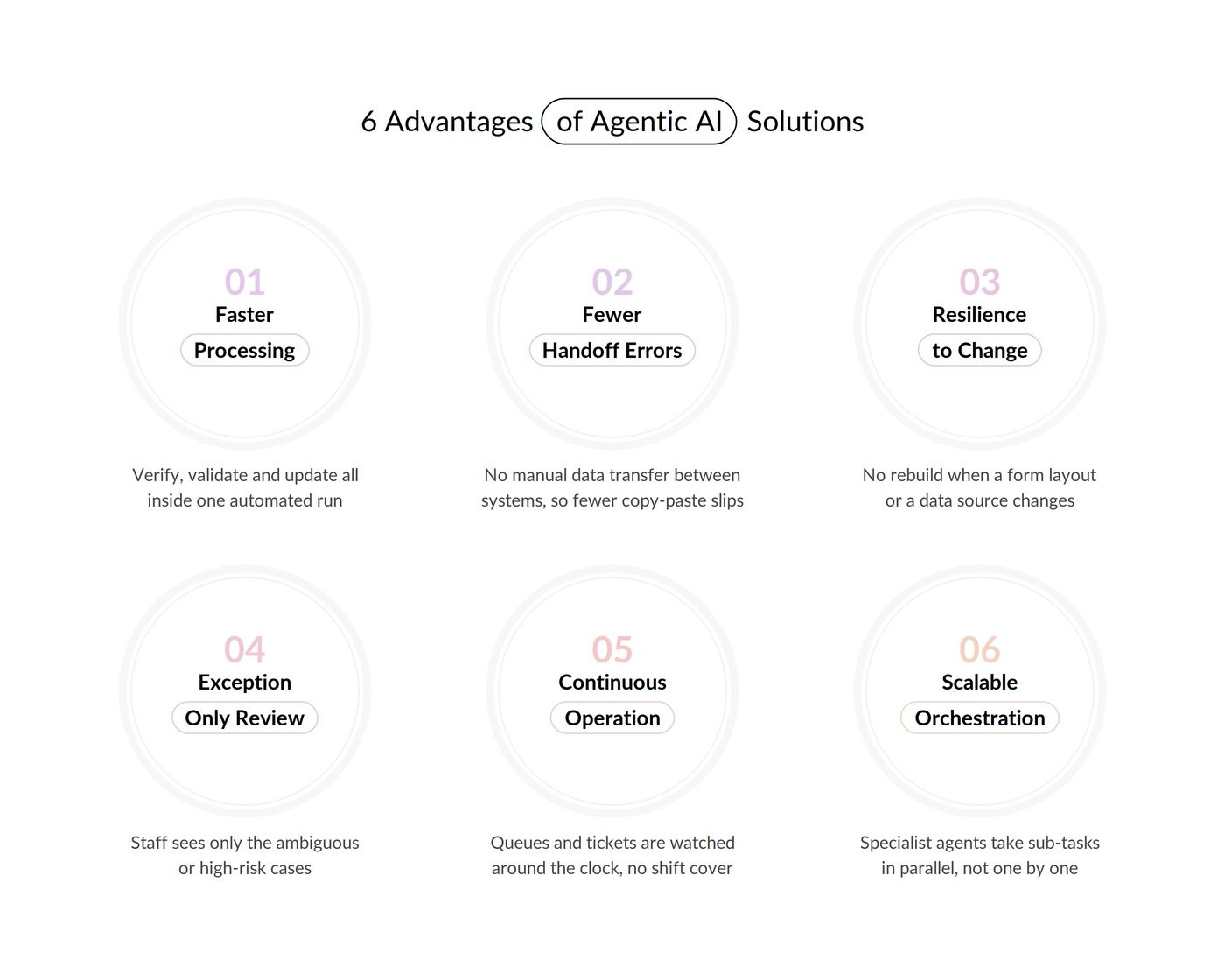
Agentic AI solutions reduce the manual coordination operations that occur between systems. Key benefits include:
1. Faster end-to-end processing
Multi-step workflows that include verifying a database, validating a result, and updating a record all occur in a single automated run.
2. Fewer manual handoff errors
Removing manual data transfer between systems reduces the mistake rate caused by copy-pasting information across tools.
3. Resilience to changing inputs
It doesn't require a rebuild every time a form layout or data source changes.
4. Exception-only human review
Staff handles only the cases flagged as ambiguous or high-risk, others are handled by AI.
5. Continuous operation
Agents monitor queues, tickets, or transactions around the clock without needing shift coverage.
6. Scalable orchestration
To save time, multi-agent setups enable specialized agents (research, validation, and reporting) to tackle their respective sub-tasks in parallel, rather than one system attempting to do everything sequentially.
Quintagroup's Agentic AI Deployment Framework (AADF)
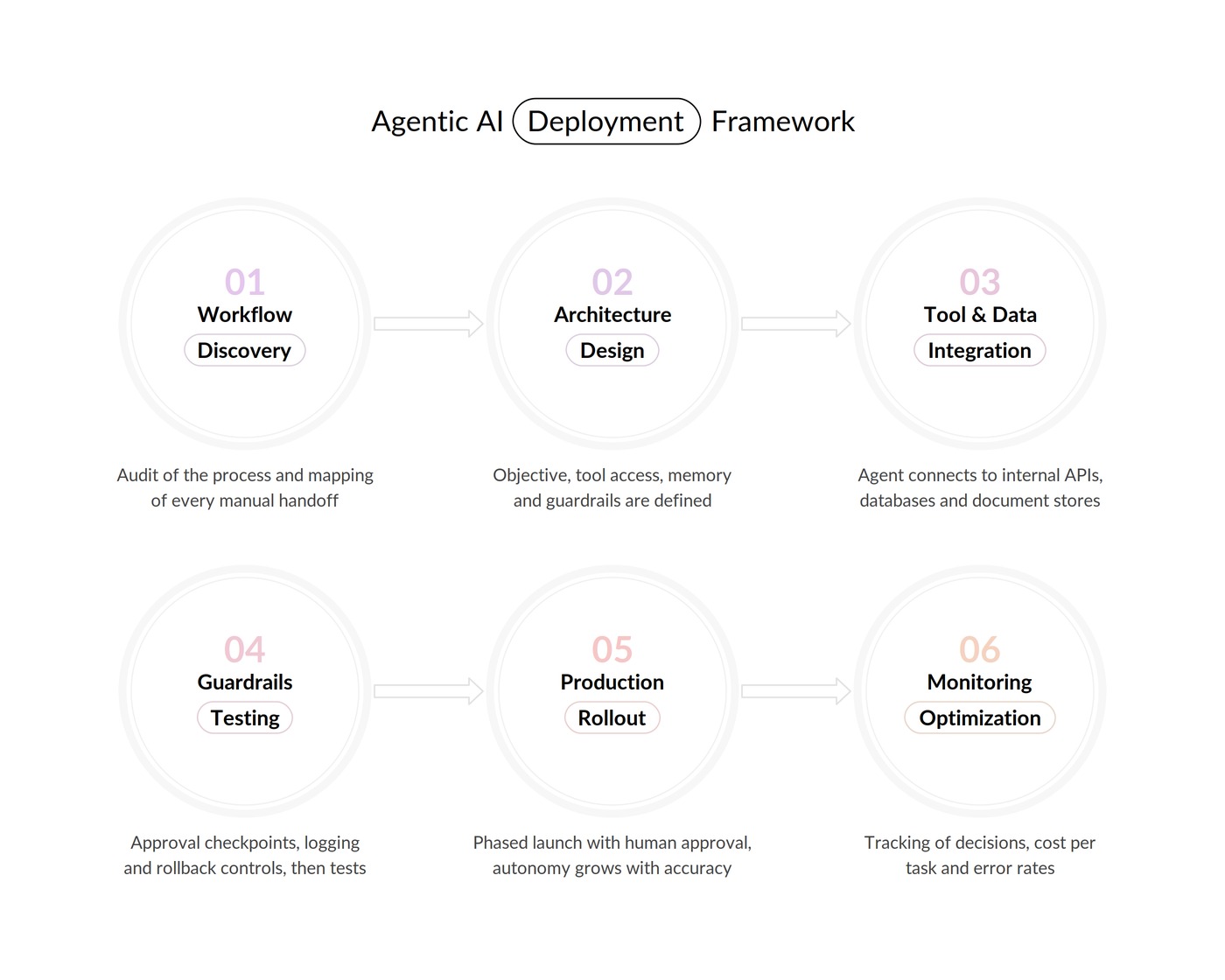
Quintagroup structures every agentic AI services engagement around six phases:
Phase 1: Workflow Discovery
Audit of the target business process, including mapping of all manual handoffs and decision points that an agent may be responsible for.
Phase 2: Agent Architecture Design
The agent's objective, tool access, memory approach, and guardrails are defined using frameworks such as LangGraph, CrewAI, or AutoGen, depending on the complexity of the process.
Phase 3: Tool and Data Integration
Connection of the agent to internal APIs, databases, and document repositories.
Phase 4: Guardrails and Testing
Implementation of approval checkpoints, action logging, and rollback controls, followed by structured testing against edge cases.
Phase 5: Controlled Production Rollout
Phased deployment, beginning with human-in-the-loop approval for all agent actions. The autonomy increases when the accuracy is gradually proven.
Phase 6: Monitoring and Continuous Optimization
Ongoing tracking of agent decisions, cost per task, and error rates.
A standard AADF engagement for a single business workflow runs 4-6 weeks; multi-agent systems spanning several departments typically take 6-8 weeks.
Tech Stack for Agentic AI Deployment Framework
Quintagroup selects the stack for each project depending on latency constraints, data sensitivity, and the number of tools that each agent should call. The core technologies include:
- Anthropic Claude and OpenAI: Reasoning and decision-making layer for agent planning and execution.
- LangGraph, CrewAI, or AutoGen: Multi-agent orchestration frameworks for coordinating specialized agents and managing complex workflows.
- Pinecone or pgvector: Vector databases for retrieval-augmented generation (RAG), giving agents accurate, up-to-date access to internal documents and knowledge bases.
- Python and FastAPI: Tool integration layer connecting agents to internal APIs, databases, and third-party systems.
Which Industries Benefit from Agentic AI Solutions?
- FinTech: Monitor transaction patterns, cross-check them against risk databases, and generate audit-ready summaries.
- Professional services: Draft first-pass contract reviews or research memos, pulling from the company’s knowledge bases.
- Customer operations: Resolve multi-step support tickets end-to-end, escalating only exceptions.
- eProcurement and government platforms: Validate bid documents against compliance rules and flag exceptions for human review.
Get an AI Agent Solution Built for Your Workflow
Agentic AI services deliver the most value when it is scoped to a specific, well-understood business process. Contact Quintagroup to schedule a workflow discovery session. Describe the process you want automated, and the team will map an estimate within 5 business days.
Frequently Asked Questions
What is agentic AI and how is it different from a regular AI chatbot?
Agentic AI is an AI system that plans and executes multi-step activities autonomously, uses tools and APIs, and modifies its actions in response to results. A normal chatbot responds to one prompt at a time, with no ability to act outside of the discussion. Agentic AI systems are designed for workflows, not individual conversations.
How long does it take to build an agentic AI solution?
Timeline depends primarily on how many internal systems the agent needs to access. Using Quintagroup's Agentic AI Deployment Framework (AADF), a single-workflow agentic AI deployment takes 4-6 weeks. Multi-agent systems spanning several departments or requiring custom tool integrations typically take 6-8 weeks.
Is agentic AI safe to use for business-critical processes?
Yes, if safety precautions are incorporated from the beginning. Quintagroup's AADF contains a dedicated guardrails and testing phase in which every agent activity is documented and rollback controls are tested before production. The production rollout begins with human-in-the-loop permission, and agent autonomy is increased only if accuracy is validated.
What technologies does Quintagroup use for agentic AI development?
Quintagroup’s agentic AI services use: Anthropic Claude and OpenAI for reasoning, LangGraph or CrewAI for multi-agent orchestration, vector databases such as Pinecone or pgvector for retrieval-augmented generation, and Python/FastAPI for connecting agents to internal APIs and data sources. The stack is chosen per project based on data sensitivity and tool complexity.
How much does an agentic AI solution cost?
The cost depends on the number of systems the agent integrates with and the level of autonomy required. A single-workflow agentic AI deployment often requires less resources than a multi-agent system covering multiple departments. Contact Quintagroup for a fixed-price estimate based on your desired workflow and current manual method.